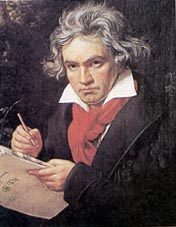
Beethoven: The Composer as Hero
1. Briefly describe Beethoven's relationship with the contemporary aristocracy.
2. What is the form of the first movement of Beethoven's "Pathetique" sonata?
3. What is the Heiligenstadt Testement and what is its significance?
4. What are the major works of Beethoven's "Heroic Period"? What dates are
usually assigned to this period?
5. What are the majors works of Beethoven's 3rd creative period?
6. Name at least 6 ways in which Beethoven can be viewed as a rebel or iconoclast,
giving specific examples from his compositions.
1. List at least seven elements of the cultural and intellectual
context of the 19th century that seem to illuminate Romantic musical
style or which have analogies with Musical Romanticism.
2. Summarize the key elements of Romantic Musical Style, dealing
with melody, harmony, expression, rubato, sonority or tone color,
and forms.
3. What new genres became important during the Romantic era?
4. What changes took place in the orchetra between the Classical
and Romantic eras?
5. What is a piano transcription? What is a sustaining pedal?
6. What is the distinction between absolute and program music?
7. What is a symphonic poem?
8. What is the name given to German art songs of the 19th century?
What performing forces are typically called for in the performance
of Lieder.
9. Briefly trace the most important events in Schubert's career.
10. Explain the difference between strophic form, modified strophic
form, and through composed form. Which form is used for: "The
Erlking," "The Trout," Heidenröslein"?
11. Briefly cite examples of Schubert's ability to use musical
techniques to underline elements of plot or characterization in
"The Erlking."
12. Describe at least two ways in which Schubert's music highlights,
or emphasizes Gretchen's emotional state--as exposed in the poem--in
"Gretchen am Spinnrade."
1. What is program music and what genres typically had programs?
2. What nationality was Berlioz?
3. What was Berlioz's musical training like?
4. What was Berlioz's primary means of financial support throughout
his career?
5. In what ways was Berlioz's obsession with literature manifest
in his compositional output?
6. What unusual instruments did Berlioz employ in his orchestration?
7. What is the genre of Berlioz's Symphonie Fantastique?
8. Who was Harriet Smithson and what is her relationship to the
Symphonie Fantastique?
9. What is the technique that Berlioz called his idée fixe?
Explain its importance both musically and as a narrative device
in the composition.
10. What role does the Gregorian Chant "Dies irae" play
in the Symphonie Fantastique? Why did Berlioz choose this particular
chant?
11. What is diminution and how is it used in the last movement
of the Symphonie Fantastique?
12. What is a fugato and how does Berlioz use this technique to
telling effect in the last movment or Withces Sabbath to the Symphonie
Fantastique?
13. What is the effect known as col legno?
1. What was Schumann's relationship to the "New Journal
of Music" (Neue Zeitschrift für Musik).
2. What type of composition did Schumann devote himself to during
the 1830s? In the year 1840?
3. According to Wright, what factors help to explain the relative
lack of women composers during the 18th and 19th centuries?
4. Briefly recount the musical career of Clara Wieck (Schumann).
5. What was Chopin's nationality?
6. What city was the center of Chopin's career, and how did his
music-making there differ from the career path taken by most 19th-century
virtuosos?
7. What instrument was the center of Chopin's compositional interest?
8. What are the musical characteristics of the Mazurka?
9. What is a piano Etude?
10. What effect did Paganini's playing have on Franz Liszt?
12. Describe the "three-hand trick" in Liszt's music and how the effect is realized on the piano.
Connect to the Wagner Archive, a very well done Web Page.
1. Name several composers who were noted composers of Romantic
opera.
2. What was the relationship between Italian opera and opera in
other languages in the 19th century?
3. What is the relationship between voice and orchestra in most
bel canto opera?
4. What two composers would you associate especially with bel
canto?
5. Name at least 4 operas by Giuseppe Verdi.
6. What is recitativeo accompagnato?
7. What is a cabaletta?
8. Name three of Wagners early (pre-1850) operas.
9. What 4 operas make up Wagner's "Ring of the Nibelung"?
10. Name three of Wagner's later operas other than the "Ring"
cycle.
11. What did the terms music drama and Gesamtkunstwerk connote
for Wagner?
12. In what ways do Wagners music dramas differ from contemporaneous
Italian opera?
13. What is a Wagnerian leitmotif? How are leitmotifs used in
the Prelude to Tristand und Isolde?
14. Describe in a general way Wagner's use of chromaticism.
15. Be able to follow all of the major stuctural features in the
"Liebestod" from Tristand and Isolde; see the Wright listening guide.
1. What dates does Wright suggest for "Late Romanticism"?
2. Contrast the structural outlines of typical romantic symphonies
with classical symphonies of Haydn and Mozart.
3. What type of composition is Brahms's German Requiem.
4. What evidence does Wright cite to suggest that Brahms was a
very conservative composer? Are there some respects in which Brahms
is a progressive composer?
5. Name the principal works from Brahms's output cited by Wright in the textbook reading.
6. What forms or formal procedures are combined in the finale to Brahms's Symphony No. 4 in E minor?
1. What general objections did French musicians of the 1890s
voice regarding Germanic music generally and Wagner's compositions
in particular?
2. Name 4 of Debussy's most important works and give their genres.
3. In what ways does French Impressionistic music seem to share
common aims or orientations with the Impressionist painters and
the symbolist poets?
4. What is the relationship between Mallarmé's poetry and
Debussy's "Prelude to the Afternoon of a Faun"?
5. How would you rate the relative importance of rhythm vs. tone
color in the structure of Debussy's "Prelude to the Afternoon
of a Faun?" What does Wright mean by his statement that [in
much of Debussy's music] color and texture begin to replace melody
as the primary agents in the creation of musical form?
6. For what instrument did Debussy write his two books of Preludes
(1910 and 1913)? Are these pieces program music or absolute music?
Why?
7. Describe the structure of the whole-tone scale. Why is there
no strong sense of a fundamental pitch or tonic in music that
employs this scale?
8. What is an ostinato? How is the technique used in Debussy's
"Sails" (Voiles, 1910)?
9. How many notes are there (per octave) in a pentatonic scale?
Where is Debussy likely to have heard this tonal structure?
10. In addition to Debussy, what other composers are usually considered
to be Impressionists?
11. Give at least four examples of musicians' fascination with
the exotic during the late 19th and early 20th century.
12. Review and be able to list the features of Impressionism listed
in your text.
13. Which of the piano piece by Debussy that you have studied
makes extensive use of the whole tone scale? What consequences
for the sound of a composition does this structure have?
14. How is Debussy's aesthetic goal of creating music that whose
appeal is "immediate" realized in his compositions. With which musical
elements does Debussy seem especially concerned, and how does
this accord with his desire for immediacy of effect?