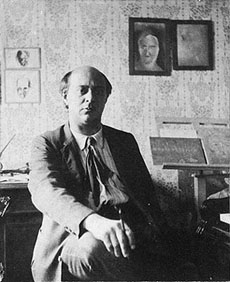
MU 111 Supplementary Listening #13
|
|
|
Before listening to the works on these pages,
read the assignment in Todd, Discovering Music, I. Schoenberg, "Valse de Chopin" from Pierrot Lunaire" After reading the assignment, listen to Schoenberg's "Valse de Chopin," following the listening guide in the textbook.
Listen to Schoenberg, "Valse de" Chopin" from Pierrot Lunaire II. Schoenberg, "Trio" from the Suite for Piano (1924) Schoenberg's exploration of the free use of dissonance in his expressionist works profoundly enriched his musical vocabulary. Yet without the organizing force of tonality, he found it difficult to write coherent, expressive works of the type that he was seeking. In the early 1920s he devised a system of composing with all twelve notes of the chromatic scale, that became known as serialism, serial composition, or twelve-tone composition. It was perhaps the compositional idea whose implications were the most profound for music in the twentieth century. To grasp fully Schoenberg's concept of serialism would require several years of studying music theory. You can begin to grasp the major ideas, however, by contrasting 12-tone compositions to the tonal music with which you're more familiar: In tonal music, the relationships between notes is predetermined for a composer before he or she even begins to write. The tonic note will be the most central pitch. The tonic triad, the fundamental triad, will be built of the notes forming the intervals of a third and fifth above this tonic pitch. The distance between the eight notes of the scale cannot be changed, and so on. In tonal compositions, then, a whole constellation of relationships governing notes and their function is given and unalterable. The exciting feature of Schoenberg's serial method of composition is that a composer can reinvent the entire musical world with each piece. Schoenberg's notion was to begin composing not with a major or minor scale, but with all twelve notes available in our system of musical tuning, arranged in any order that the composer might choose (in atonal theory each note is assigned a number; note that the numbering system starts with 0, not 1):
In place of the fixed content of the scale, Schoenberg used the ordering of the twelve tones a primary compositional decision for composers. A composer, for instance, might choose to order the 12 pitches as follows in order to use them as the basis for a composition:
Such an ordered series of twelve notes, like C, E, F . . . (or 0, 4, 5 . . . ) above, Schoenberg called a twelve-tone row or simply row. A row serves as the basis for a twelve-tone composition. In a serial work, the 12-note row tends to be used in the same order throughout the piece, and the important thing about maintaining a fixed ordering is that the intervals between pairs of adjacent notes in the row thus remain fixed. By carefully ordering the twelve tones in a row, a composer can influence the resulting intervals, thus altering the tonal materials that will be available in composing a piece. For instance, a composer could create a row that was full of spiky, dissonant sounding seconds, or, in constrast, create a row that gives rise to many thirds and fifths, more consonant intervals. Much of a twelve-tone, or serial composition will be produced by a series of operations on the composer's chosen row. These operations for manipulating the row are not particularly new; we've encountered them from the Middle Ages onward (though they are applied to 12-tone music with unusual strictness and rigor). In Schoenberg's serial compositions, the row is manipulated using the following transformations (or two or more of the following in combination): Transposition--moving the row up or down to a different starting note. The example below shows a row, and below, it's transposition up a whole step (or whole tone). Figure out the math of transposing up by a whole step (=two half steps):
Inversion--turning the row upside down, so that if, for example, the interval between the first pair of notes were a third going up (C (0) up to E (4), as in the example below), the inversion would begin with a third going down (C (0) down to G# (8) below). The example shows our original row and its inversion; notice the changes in direction: where the notes in the original row moved up, notes in the inversion move down. Figure out how to derive an inversion mathematically. [Hint: since there are 12 notes in an octave, 12 is a pretty important number in atonal theory.]
Retrograde--beginning with the last note, reversing the order of the row. (Machaut used this same technique in the 14th century.)
Retrograde Inversion--the inversion in reverse. Derive this one for yourself. The implications of Schoenberg's system become even more complicated and profound. Suppose we start with the row with which we've been working, and not only invert it, but transpose it up a major 6th.
These operations produce an interesting result: if you carefully compare the top and bottom rows, the notes in the first and second halves of these rows change in order but not in content (i.e., both first halves contain 0, 2, 4, 5, 7, and 9). This sort of relationship--common in the works of Schoenberg and his school--is no accident. The ability to invent rows that still share certain groups of common notes, even after transformation (by inversion, transposition, and retrogression) enabled Schoenberg to produce music that had a new type of organization: free of the limitations of tonality, yet rich in purely musical connections (every few notes are variations on many other short sets of notes used elsewhere in the piece). What does Schoenberg's serial music sound like? As an example, listen to a portion of Trio from Suite for Piano (1924).
Listen to Schoenberg, "Trio" from the Suite for Piano (1924) : Go to MU111 home page |