Horseshoe Nails, Neumes, and Deception:
Where Did Mayo-8 Come From?
Anthony Bundock, '23
.jpg)
Otto Ege indicates in his description of Mayo-8 that the manuscript is from an Italian Antiphonary copied around the year 1460 A.D. Several readily observable characteristics corroborate this. First, the Gregorian staff takes the form of four red lines with square notation. This had been the official standard for the Roman Curia since the mid-thirteenth century and thus was eventually adopted throughout central Italy (Haines, 2011). Second, the ruling of the manuscript is characteristic of that of late Medieval Italy in that it uses single prick lines to set the text on the page, a technique that would have required the rastrum for setting the proximal lines of music notation (Haines, 2011). The rastrum, a multi-pronged writing instrument used to draw multiple parallel lines at once, was not in common use until the fourteenth century (Haines, 2011). In addition, it was the fifteenth century that saw a revival of monastic reform movements on the Italian peninsula, during which time monastic scribes would have been at their most prolific as they set to work redrafting their manuscripts in accordance with the standards set out by the Roman Curia and its commendatory abbots (Dyer, 2019).
Curiously, while there are very limited pricking patterns to indicate ruling units along the long side of the manuscript, there are many along its short edge, a section that would often be lost during the trimming of a codex. This, in addition to the presence of partially erased Latin text running perpendicular to the top layer of writing confirms the leaves’ identities as palimpsests. Unfortunately, attempts to discern the text or notations of the effaced writing have been unsuccessful. This did not prevent Ege from postulating that some of the marks are signs of horseshoe nail notation. The issue with this theory, however, is that use of horseshoe nail notation from the thirteenth through the fifteenth centuries was primarily confined to the regions of modern-day Germany (Bent, 2001). Thus, the book would likely have to have been originally written somewhere north of the Alps, carried to a monastery in Italy, effaced, and then re-scripted. While this is possible, there is insufficient notational evidence to support this claim.
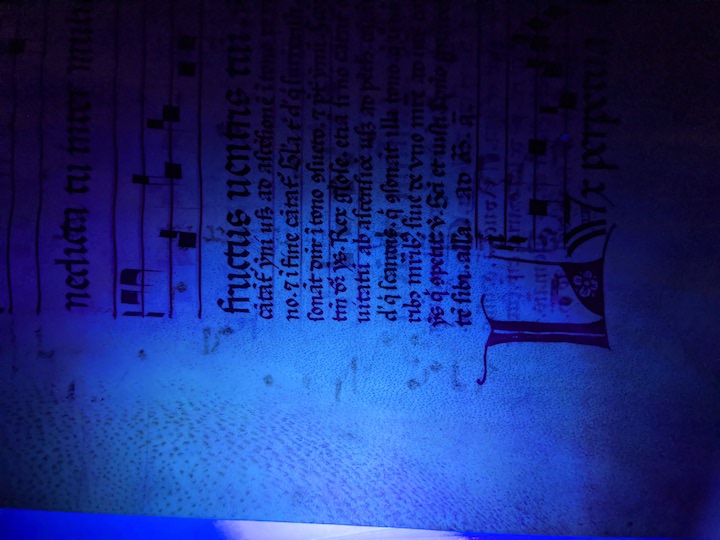
An alternative hypothesis for these mystery markings may be that they are old adiastematic notations that had been effaced to make way for Guidonian staff notation. Adiastematic and partially neume-based notations persisted in the monasteries of southern Germany and Italy through the early fourteenth century (Bent, 2001). Of the few legible adiastematic neumes remaining on the Mayo-8 today, ligatures predominantly associated with manuscripts of Norman, Messine, Beneventan, and Gall influence all make an appearance (Parrish, 1957). Such diversity is consistent with the various traditions that influenced scribes on the Italian peninsula. While Ege may have been mistaken in his description of the effaced neumes as horseshoe nail notation, he was correct in recognizing that Germanic influences were present within the manuscript. Hufnagel, a German Gothic neume system would be the chronological intermediary between the old adiastematic notations and the new Guidonnian staff notation for several monasteries in northern Italy (Haines, 2011). And the presence of the unique Gall torculus (recto of second leaf near signature ‘L’, top image), in reference to the Abbey of Saint Gall in Switzerland, almost certainly narrows the potential origin of this manuscript to northern Italy (Haines, 2011). The Mayo-8 manuscript, however, does not show any signs of true Hufnagel ligature which, had it been from the eastern parts of northern Italy, it would possess rather than more standard neumes. This leaves northwest Italy, specifically Piedmont, as the only remaining possibility for the geographic origins of these leaves.
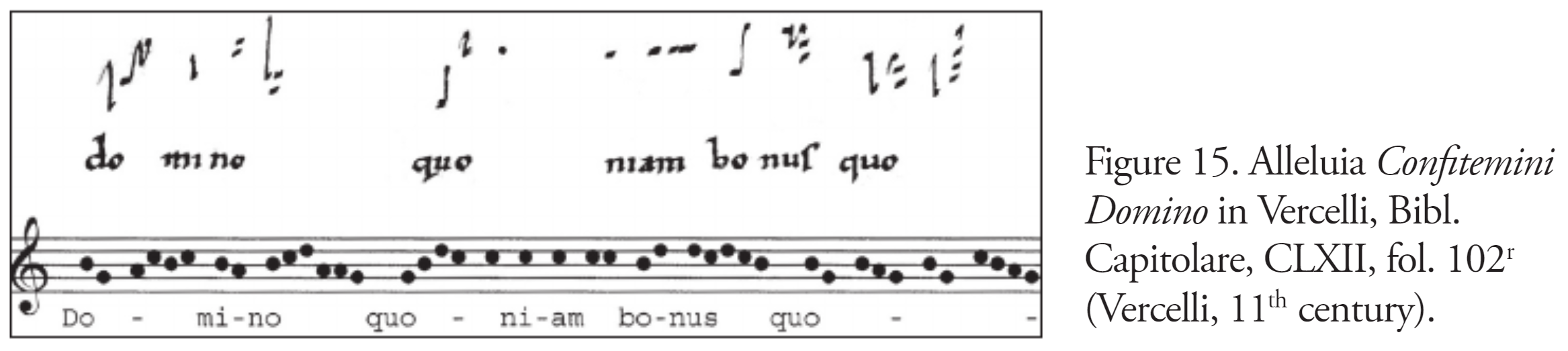
Comparing the effaced ligatures of the Mayo-8 with samples from Medieval monasteries in Piedmont, one candidate for a potential home for the manuscript stands out, Vercelli. Vercelli samples share the same thin and expressive virga as well as the same conspicuous torculus resupinis (Haines, 2011) which is not seen in any of the other samples from Piedmont. From this, one arrives at a plausible hypothesis for where and when the Mayo-8 came into being. That is, somewhere in or around the city of Vercelli near the beginning of the fourteenth century (see below the effaced ligatures of Mayo-8 side-by-side with Haines’s sample of notation from Vercelli).
Works Cited
Bent, Ian D. et al. “Notation.” https://www.oxfordmusiconline.com/, Oxford Music, accessed 20 Jan. 2001, https://doi.org/10.1093/gmo/9781561592630.article.20114. Dyer, Joseph. “Benedictine Monks.” Oxford Music Online, accessed 30 Dec. 2019, https://doi.org/10.1093/omo/9781561592630.013.90000369479. Haines, John. The Calligraphy of Medieval Music. Turnhout: Brepols Publishers, 2011. Parrish, Carl. The Notation of Medieval Music: the Development of Musical Notation from the 9th to the 15th Century. New York: W. W. Norton, 1957. University of Waterloo Cantus Database, http://cantus.uwaterloo.ca/chant/154701.