Making Medieval Manuscripts
Abigail Carson, '22
Palimpsests were made by taking parchment that had already been written on and then scraping off the existing text with pumice, a form of volcanic glass (British Library, n.d.). After being stripped, the palimpsest could be written on again with the new information; however, the process was not perfect and, luckily for us, we can still see remnants of what was previously on the pages of Mayo-8, especially with the help of a UV light (see Image 1). 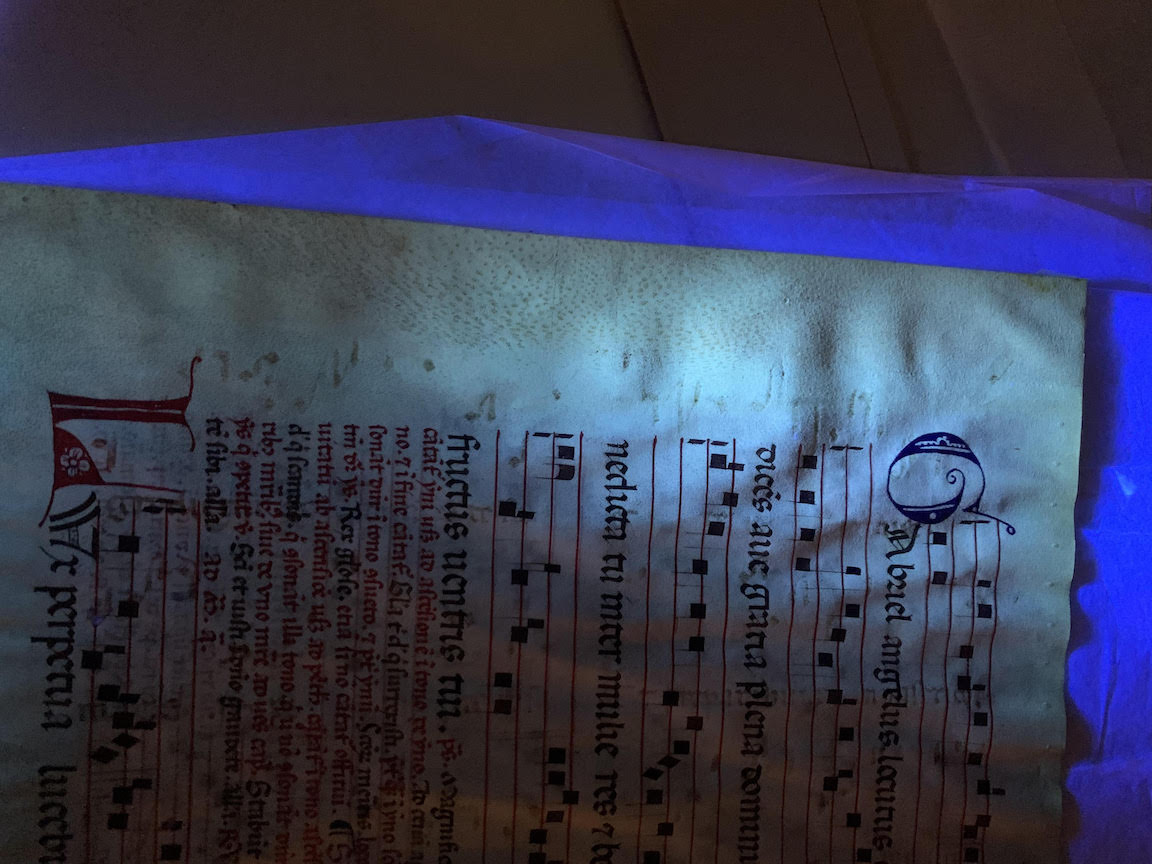 We can see on our manuscripts two indications that they were reused. The first (and perhaps the most obvious) is the faint lettering that goes horizontally across the page. We can see here a few faint Latin words and even some early evidence of music notation. However, the lettering cuts off abruptly at the bottom of the page leading us to believe that these manuscripts were once much larger and were cut to fit their current size. This theory is supported by the small pin holes that line the tops of the pages, indicating that they were at one point either bound vertically, or, more likely, were once oriented that way as an earlier manuscript. Otto Ege believed this palimpsest text to be horseshoe nail notation however it’s difficult to know for sure and I would argue that notation here is a bit too varied in its neume types to be horseshoe nail. It’s rare for musical manuscripts to be palimpsests, and therefore this gives us more insight into the lives of the scribes who made it.
The next stage in manuscript making was the transcription process, and this was also not as easy as it may seem. In her essay, “God is Witness,” Luisa Nardini suggests that many manuscripts were not copied from existing music but were instead dictated and written down by ear. This is evident through varying notations of a single melody in the same manuscript, indicating that they are the result of musical dictation. “In this perspective, notation truly becomes the ‘stenographic’ representation of a melody that is not simply remembered or copied from a written exemplar, but that is also transcribed while listening to a live performance” (Nardini 2012, 54). At the very least, manuscript writing was certainly not a silent process, as reading in one’s head did not exist at the time.
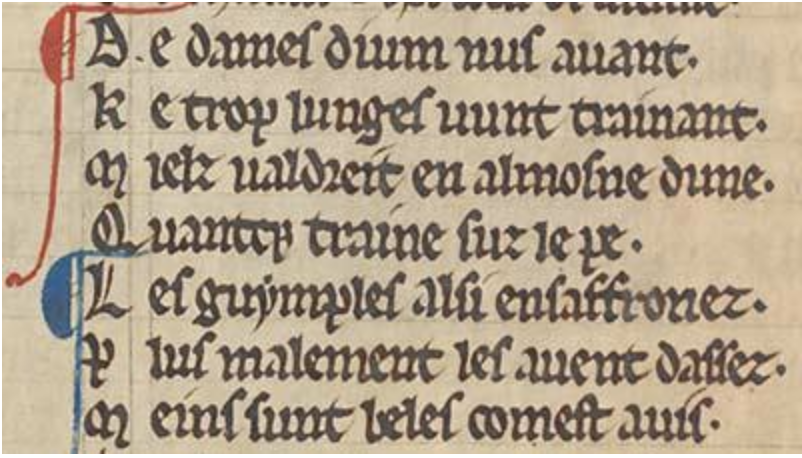 There were also many scripts used in manuscript writing ranging from the simple to the ornate, often dictated by location and time period. It is difficult to assign a single script style to a manuscript, as each scribe had their own unique handwriting and scripts were often combined. But our Mayo-8 script closely resembles that of Textura with its distinct separation of letters. However, it is different in that the bottoms of letters (most notably the m’s and n’s) lack the customary diamond shape often seen in Quadrata forms of Textura (The University of Nottingham, n.d.). (See image 2 and Mayo-8) This could be the result of the individual scribe’s preference, or by the specific pen he used or merely by his schooling.
 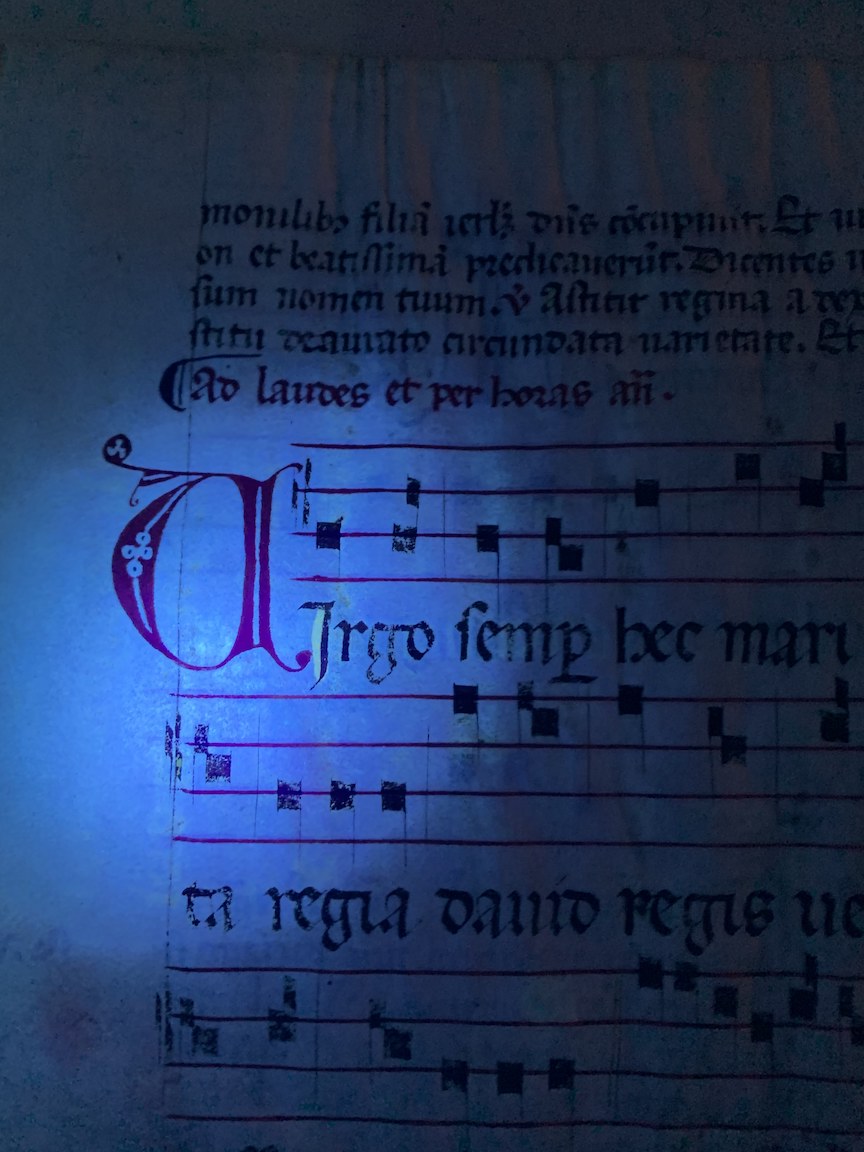 The inks were themselves the results of long and tedious processes. Blue dyes were especially difficult to produce, being the result of fermenting a noxious weed called Isatis tinctoris or woad. In fact, the making of blue dye was such a revered process that once indigo came on the scene woad producers were able to get its production banned under threat of death in Elizabethan England (Philips 2007, 10).
We can see that even the process of procuring all the necessary materials for a manuscript involved many people doing different, specialized tasks. Manuscript making was a specialized art form, requiring a number of people, resources, and years of training on the part of the scribe. Not only did manuscripts serve a practical purpose, but they were also a physical manifestation of the resources of the church, a way to show off skill and wealth. Therefore, Mayo-8 should be revered not just as a historical artifact, but also as a work of art, the product of hours of manual labor, and a physical representation of religious reverence, technical skill, and beautiful music.
British Library, “Glossaries.” Catalogue of Illuminated Manuscripts,
https://www.bl.uk/catalogues/illuminatedmanuscripts/GlossP.asp.
Adapted from: Michele P. Brown. Understanding Illuminating Manuscripts: A Guide to Technical Terms.
London: The J. Paul Getty Museum, and The British Library Board, 1994.
Grömer, Karina, Gabriela Russ-Popa, and Konstantina Saliari. "Products of Animal Skin from Antiquity to the Medieval Period." Annalen Des Naturhistorischen Museums in Wien. Serie A Für Mineralogie Und Petrographie, Geologie Und Paläontologie, Anthropologie Und Prähistorie 119 (2017): 69-93.
Nardini, Lusia. "God is Witness: Dictation and the Copying of Chants in Medieval Monasteries."Musica Disciplina 57 (2012): 51-79.
Phillips, Kandy Vermeer. "Color in Medieval Manuscript Painting." The Botanical Artist 13, no. 1 (2007): 8-10. http://www.jstor.org/stable/45014402.
The University of Nottingham, “Handwriting Styles.” Handwriting Styles - The University of Nottingham, www.nottingham.ac.uk/manuscriptsandspecialcollections/researchguidance/medievaldocuments/handwritingstyles.aspx.