Modes in the Mayo-8 Chants
Karl Lackner, '22
The modes provide a framework for understanding plainchant with modern musical concepts. The presence of modal structures in plainchant creates a kind of aural uniformity throughout the genre, associating it with a characteristic and an immediately identifiable sound, like the harpsichord in the baroque or power chords in rock. In a journal article on plainchant, Kenneth Levy calls modality “the single most homogeneous feature of Gregorian plainchant” as some form of it can be seen in all styles of chant, from psalms to antiphons, and from melismatic chants to syllabic chants.
What is mode?
Modes can be understood as collections of notes derived from a major scale and classified by their “final," or the last note, and their “ambitus," or the range of notes from lowest to highest. Another way to think about modes is to imagine different arrangements of half-steps (H) and whole-steps (W) between eight notes spanning an octave. For example, the Dorian mode consists of (W-H-W-W-W-H-W) and the Mixolydian mode consists of (W-W-H-W-W-H-W).

The final note is not always the lowest note of a chant, so two different classifications of mode exist in medieval chant: authentic, and plagal. A chant in an authentic mode will have its lowest note on its final, while a chant in a plagal mode will have its lowest note on a tone different from the final note.
There are a total of eight modes in medieval chant. They are identified by four different final notes (D, E, F, and G), each note having an authentic mode, and then a plagal mode labeled with the prefix “hypo-”. These modes are: Dorian, Hypodorian, Phrygian, Hypophrygian, Lydian, Hypolydian, Mixolydian, and Hypomixolydian.
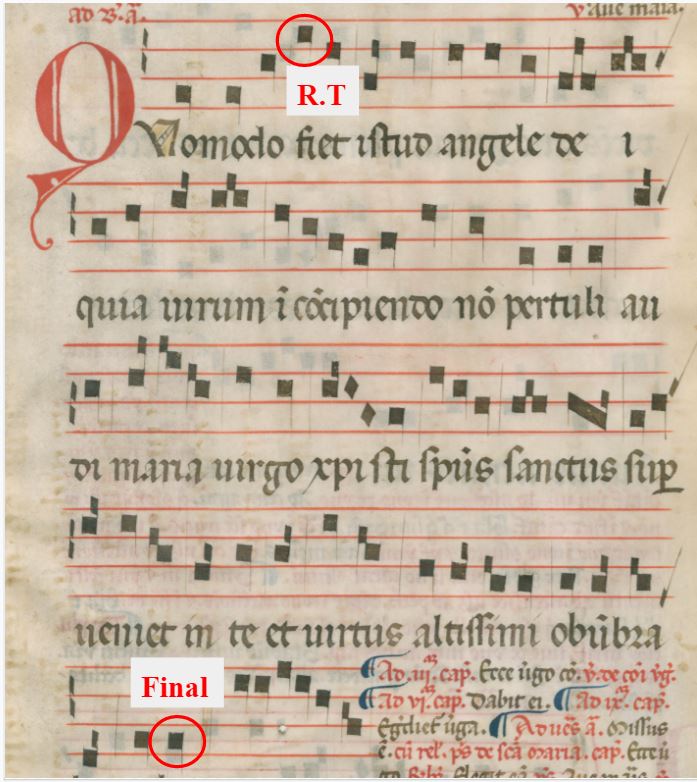
Each mode also has a specific “reciting tone” which serves as a structural note for the chant and is repeated often throughout the chant, particularly near the beginning. Plainchant was exclusively monophonic, meaning its texture consisted of a single-line melody, without accompanying harmonies or chords. Without an underlying harmonic structure, monophonic music like chant relied upon a modal framework to provide tonal organization.
How does mode apply to our chants?
As an example, the chant starting with the words “Quomodo fiet istud” (below) is in the Mixolydian, or the 7th mode. We know this because the final note is G, making it either Mixolydian or Hypomixolydian, and the lowest note is also G, making it the authentic form of the mode. The pitches can be determined from the clef on each staff line denoting where C is. The chant, “Gabriel angelus locutus est” is also in this mode

“Trahe me post te” is in the 8th or Hypomixolydian mode. This means it shares a final note
of G with the mixolydian chants, but has some tones that go below that final.
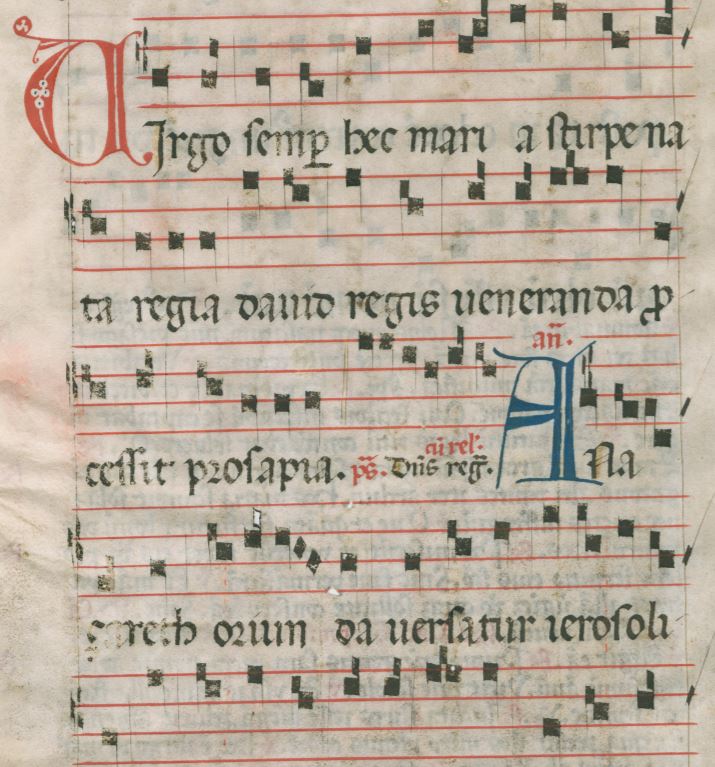
The chants “Virgo semper hec Maria” (pictured below) and “Lux perpetua lucebit sanctis” are both in the first, or Dorian mode, which tells us that both their final and lowest notes are D, though "Virgo semper hec Maria," briefly touches on the C below the final, a characteristic feature of many mode 1 chants.
“A Nazareth oriunda” is in the Hypodorian, or second, mode since it’s lowest note is different from its final, D.