Physics home

Astronomy home

Astronomy Courses Astronomy Requirements

Astronomy 151
Study Guide
-->

Research in
Infrared Astronomy

Research Files

Murray F. Campbell,
William A. Rogers Professor of Physics


Hubble Space
Telescope Photos

NASA's Observation
of the week

Colby prepares students for top Ph.D. programs in astrophysics, although its astronomy courses are also accessible to qualified students of all majors. In Fall, 2010, there will be four recent alumnae/alumni working Ph.Ds. at the University of Washington, Yale (two), and the University of Wisconsin. Two of the four are women. The typical path to graduate work in astrophysics is based on taking all of the courses required for the physics honors major. The astrophysics part begins by taking AS 231, Introduction to Astrophysics, in the first or sophomore year. This course prepares a student for work in research in astrophysics at Colby, and gives him/her an advantage in applying for NSF-funded summer Research Experiences for Undergraduates (REUs) at national observatories and major universities. The final piece is an astrophysics Senior Project, Honors Thesis, or Senior Scholars Project.

Dustin Hickey '11, will be the third astrophysics student in consecutive years to complete a Senior Scholars Project--the most intensive and prestigious type of senior thesis at Colby. Kaylea Nelson '09 ("High Mass Star Formation and Modeling High Mass Protostellar Object IRAS 18151-1208") entered the Ph.D. program at Yale in 2009, and Jack Moriarty '10 (The Cluster Environment of High Mass Protostars) enters the same program in fall, 2010. Both Kaylea and Jack had summer positions at the the Harvard-Smithsonian Center for Astrophysics. The figure at right if from Jack's Senior Scholars Thesis. It shows the cluster environment around the High Mass Protostellar Object IRAS 11234-6154 as a color image from near- and mid-IR images made with the IRAC and MIPS cameras on Spitzer Space Telescope. The red X's show low mass early-stage protostars, and the green X's show low mass late-stage protostars. The diffuse emission is due to interstellar dust.

Cliff Johnson '07 completed an Honors Thesis based on an REU at the University of Hawaii and entered the astrophysics Ph.D. program at Washington in 2009 after a year working at the Wyoming Infrared Observartory. His thesis has been published in The Astrophysical Journal, Vol 697, 1138-1152 (2009), "Discovery, Photometry, and Kinematics of Planetary Nebulae in M 82." Danielle Nielsen '09 switched to astrophysics from Italian. After REUs at Wisconsin, Rochester, and Cerrro Tololo Inter-American Observatory, and a year working at Cerro Tololo, Danielle will enter the Ph.D. program at Wisconsin in fall, 2010.

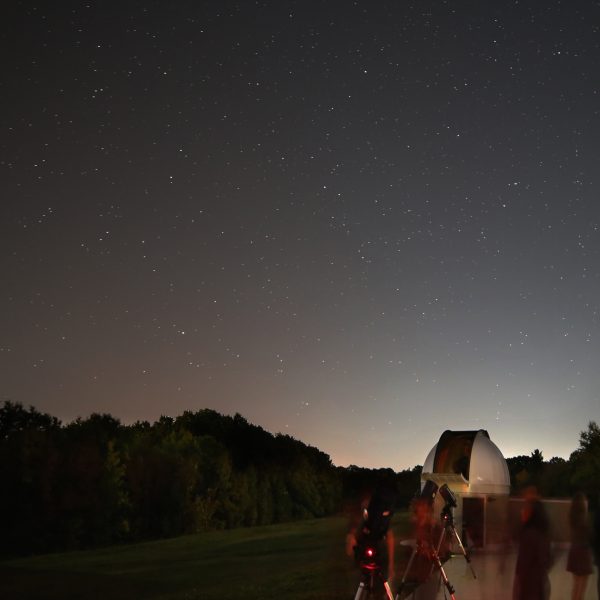
Introduction to Astrophysics, AS231, uses a 35 cm (14 inch) telescope on a research-grade computer-controlled mount. It is equipped with a liquid-nitrogen cooled CCD camera, a photometric filter wheel, a grating spectrometer, and auto-guiding. Eric Brockmeyer '06 is shown here. (Normally the telescope is operated from an adjacent, heated control room, just like a major observatory.) Eric, a physic major who did a senior project on variable stars, is now an architecture graduate student at Kent State University. In addition to future astronomers and science majors, AS231 is taken by many non-science majors with confidence in math and interest in astronomy. While grades are not important to satisfaction in the class, Kristin Saucier '04, who had majors in International Studies and Latin American Studies, is an example of a non-sciece major who got one of the top grades ever in the class.

Amy Weston '10 a Women's, Gender, and Sexuality Studies major took images of galaxies with Visual, Red, and Infrared photometric filters and combined them to a computer RGB images as a senior independent study project. With considerable experience from Phillips Exeter Academy, Amy took AS 151, Stars and Stellar Systems and then AS231. She had a summer job at the Infrared Processing and Analysis Center at CalTech working on Spitzer Space Telescope data, and is now working as an engineer at NASA Goddard Space Flight Center on a new balloon-borne millimeter wave telescope to further investigate the cosmic microwave background. The spiral galaxy M99 is shown here. In the upper left, the red star with the blue line is too bright for the camera, and the blue image has "bled" in the electronic image.

Colby Home   |   Search   |   Directory

Astronomy      Murray F. Campbell    8858 Mayflower Hill   Waterville, Maine 04901
T: 207-859-5863   F: 207-859-5868   contact

Last Modified: 06/17/10 02:54:31 PM