Listening Assignment, MU111: CD#9, Part 1 |
|
mu111 CD9, pt. 1 |
Before listening to the works on these pages,
read the assignment,
Wright, Listening to Music, Streaming Audio Requires QuickTime: Click here to download versions for Mac or Windows) I. Caccini, "Amarilli, mia bella" The first example in assigment #9 is the best known solo song, or monody, from Giulio Caccini's Le nuove musiche [The New Music], a collection of works for solo voice and basso continuo that the composer published at Florence in 1602. Monody, or early 17th-century music for a solo singer accompanied only by basso continuo, was a style developed in the 16th century, though the first important published examples of solo song date from the first years of the seventeenth century. Needless to say, the development of solo song was a precondition for the birth of opera. Caccini was born--so far as we know--in Rome, but spent most of his life in service of the Medici, the ruling family of Florence. In Florence, he belonged to a group of artists and intellectuals known collectively as the Florentine Camerata; this group of Italian humanists met regularly in the last quarter of the 16th century, developing some remarkable ideas about how a new, and more impassioned style of singing might be invented. Here, in Caccini's own words, is a description, taken from the preface to Le nuove musiche: At the time when the admirable Camerata of the most illustrious Signor Giovanni Bardi, Count of Vernio, was flourishing in Florence, with not only many of the nobility, but also the foremost musicians, intellectuals, poets, and philosophers of the city in attendance, I too was present; and I can truly say that I gained more from their learned discourse than from my more than thirty years of counterpoint study. For these most knowledgeable gentlemen kept encouraging me . . . not to esteem that sort of music which, preventing any clear understanding of the words, shatters both their their poetic form and their meaning, now lengthening and now shortening the syllables to accommodate the counterpoint (a laceration of the poetry!). Rather, they urged me to conform to the manner so praised by Plato . . . who declared that music is nothing but speech, with rhythm and tone coming after; not vice versa) with the aim that [the music] enter into the minds of men and have those wonderful [emotional] effects admired by the great writers [of Antiquity]. But this has not been possible because of the [imitative] counterpoint of modern music. How did Caccini try to make music "nothing but speech"? And how did he strive to write music that would move the listener, producing the wondrous emotional responses that he read about in Plato and other writers of Antiquity? To gain some idea, listen to "Amarilli mia bella," the first example. At first hearing you should notice several features of "Amarilli mia bella":
Listen to Caccini, "Amarilli, mia bella"
Listen again to "Amarilli, mia bella," concentrating on the form of this monody. The second half of the poem, lines 4-7, are repeated; not surprisingly, the music is repeated as well. Notice how the singer varies this written-out repeat, singing notes in addition to those that are written. He adds short groups of notes, embellishments or ornaments, at various places, especially before cadences. Listen for the added embellishments; a good singer in the 17th century was expected to be an expert at adorning a melody by adding these improvised notes. In fact, it's amazing how much of this music was made up on the spot, improvised. The continuo realization was largely improvised according to the instructions provided by the figures; likewise, vocal embellishments were improvised. Unlike later music, Caccini's printed score is not an exact blueprint for performance; it's more like a sketch with some suggestions. The history of music could almost be seen as an attempt by composers to write down their intentions more and more exactly--and in the process rob performers of more and more freedom!
following the original 1602 score below 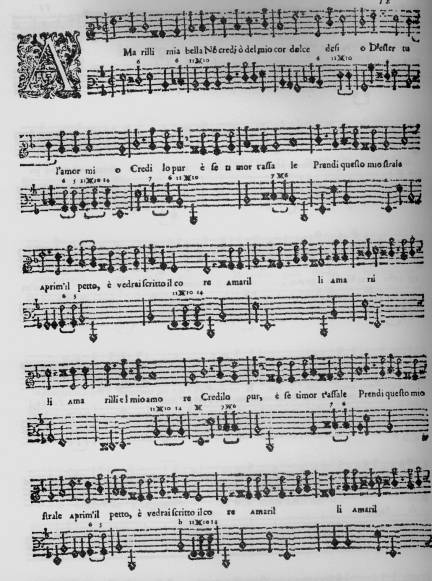 Go to CD#9 Part 2 |