Before listening to the works on these pages,
read the assignment,
Wright, Listening to Music,
Streaming Audio Requires QuickTime:
Click here to download versions for Mac or Windows)II. Alessandro Grandi, "O quam tu pulchra es"
The second work in this assignment is another monody--this time a sacred monody, "O quam tu pulchra es,"
by Alessandro Grandi. The text (see below), however, reads more like another love poem than
like a piece of church music.
Musicians believed in the power of pure melody and intelligible words--unencumbered by the
complicated imitative polyphony of the Renaissance--to move listeners.
In this power of music to sway the emotions, the Catholic church saw opportunity:
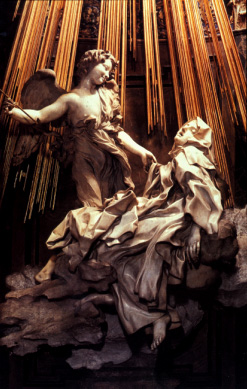
in the seventeenth century, the Catholic religion had an air of sensuality about it seems slightly foreign today.
Grandiose works of art adorned every altar and chapel;
the sweet, perfumed smell of incense was everywhere; religious poetry talked about
the love of God in the same language that poets used to talk about physical love.
Similarly, the love poetry of the Song of Songs of the Old Testament--from which this text is drawn--
came to be interpreted as referring allegorically to the Virgin Mary or to Christ's love for the Church.
The composer of this monody was Alessandro Grandi, who worked for a time as Monteverdi's assistant at St.
Mark's in Venice. He was a master of monodic writing, as "O quam tu pulchra es" shows.
Notice how Grandi uses various styles of solo song to reflect the meaning of this text from the Song of Songs:
Slow, reflective music as the singer contemplates how beautiful his lover is
(or is it the Church or the Blessed Virgin?).
[Notice how the first line "O quam tu pulchra es" returns many times, uniting the entire composition.
Notice too the way in which the first word, "O" is prolonged for a considerable time.
And listen for the the way that a second chord enters in lute--the chord changes before the singer
leaves that sustained "O." That moment sounds so poignant because the second chord turns the singer's sustained "O" from a consonance into a dissonance by altering the harmonic backdrop against which the note is heard.]
Faster, more metrical music for the singer as he addresses his love directly
Dancelike, triple meter music as he urges his love to "Come from Lebanon"
An almost desperate, falling melody, supported by unusual (chromatic) harmonies to depict the singer's languishing love near the end of the piece
 The second work in this assignment is another monody--this time a sacred monody, "O quam tu pulchra es,"
by Alessandro Grandi. The text (
The second work in this assignment is another monody--this time a sacred monody, "O quam tu pulchra es,"
by Alessandro Grandi. The text (